Nightjar
What you hear
Pieces of one kind, faded into one another. In each, a soft plucked bass steps on the roots of the chords. Above it a wide pad holds the chord’s tones, struck again at each change and pulsing gently in time, with the key’s home chord held across the changes. Quiet notes ripple over the top in an arpeggio and echo from side to side, with now and then a higher note.
Each piece settles into one key and stays there, then fades almost to nothing before the next one rises in another. A soft hiss and a little air sit over everything, and a soft tick marks a chord change. There is no binaural beat.
In Tune the four parts are Pad, Melody, Bass and Hiss, each lowered on its own.
The cover
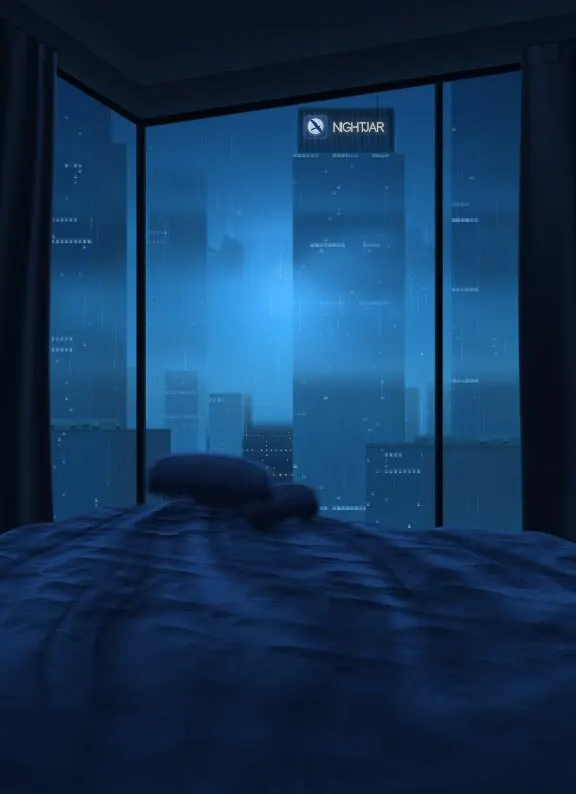
A city of dark towers in teal fog at night, seen from high up, with one deco spire’s crown lit in the fog and a rooftop sign on a far tower.
Broad, soft banks of fog go left and rise a little, so the fog in the spire’s light goes up as it goes across, and mist behind the near towers comes on over them in soft patches. The spire’s glow breathes and swells as fog drifts across its crown. Windows go on and off over seconds, a mast’s red light swells and falls, and fine drizzle lit by the city drifts down and across. Every track has a moving cover drawn live, and in the player the picture moves with the sound and rests when you pause.
When to play it
It is a calm track of 60 minutes for late at night, a slow hour or the wakeful middle of the night, and it keeps playing after the hour. Its evidence label is Comfort sound: no research reviewed, not a treatment. If you are awake at night, see awake at 3 a.m. or a wind-down routine with sound.
How it is put together
- No beat
- A soft plucked bass steps beneath a wide, gently pulsing pad, while quiet notes ripple and echo above it
- Each piece settles into one key, then fades almost to nothing before the next one rises
- It keeps playing quietly until your timer fades it out
What research says about what plays
- Comfort sound
Ambient sounds
No research reviewed. Many people find these sounds calming; this is comfort, not a treatment.
Not reviewed
These are the app's own notes, last checked against the research on 30 Oct 2026. Labels: what each one means.
Questions
Is the pulse in Small Hours a binaural beat?
No. The pad pulses gently in time with the music, at about ninety beats a minute, as a synth pad does. It is not a binaural beat or an isochronic tone, and it needs no headphones.
Can I lower the hiss or the bass?
Yes. Tune turns any sound down on its own, even parts of a track: the thunder apart from the rain, the saxophone apart from the piano. Small Hours has four parts: Pad, Melody, Bass and Hiss.
Does Small Hours loop?
No. Nightjar makes its sound live on the iPhone: none of it is a recording and none of it loops. Each piece's chords and notes are composed as it plays.