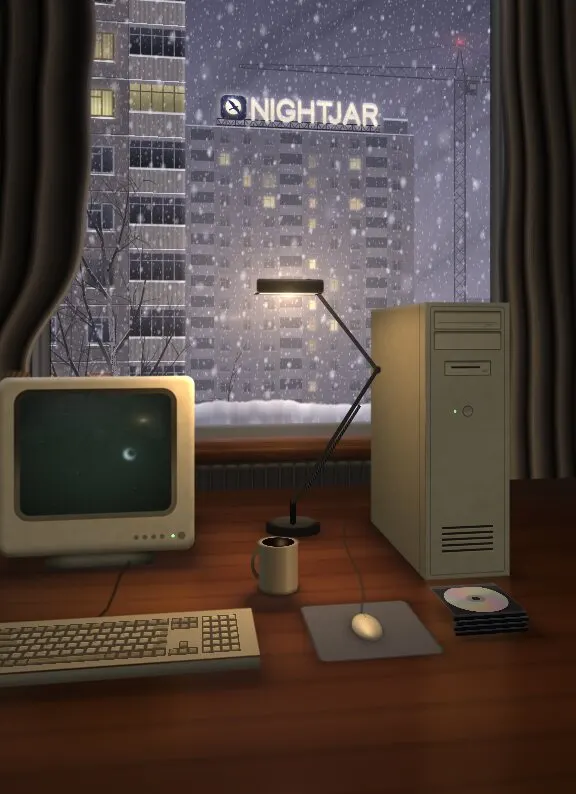
Nightjar
What you hear
A held texture rather than notes: many soft tones sound together in a dark harmony on C, old and minor-sounding, with a noisy floor between them. Each tone sits in its own place between the ears, and everything above the middle is cut away, so it sounds muffled, as if through a stone wall.
It changes slowly. The bass moves to a new note every quarter of a minute or so, and the chord shifts with it. Now and then a high line climbs a few notes and sinks back into the haze. There are no onsets, no rhythm and no beat, and a gentle top keeps the level calm.
In Tune the four parts are Chords, Melody, Bass and Rumble, each lowered on its own.
The cover
The picture is a hand-coloured engraving in deep ultramarine, violet in the half-shadows and gold where the lamplight falls. A writer’s desk stands under a colonnade at night, a lamp burning over an open codex, and the desk is empty, as if the writer had just got up. Across a paved court a temple stands under a starry sky, NIGHTJAR set into its frieze in gilt letters.
The flame licks and leans, and all it lights goes with it: the pool on the desk, the light on the column and the curtain. Its smoke climbs, curls and thins. Banks of cloud drift east, the stars twinkle and the far cypresses lean in the wind, one after another. The curtain breathes and a brazier’s fire leaps. Every track has a moving cover drawn live, and in the player the picture moves with the sound and rests when you pause.
When to play it
It is a focus track of 60 minutes for reading, writing or study late at night, and it keeps playing after the hour. Its evidence label is Comfort sound: no research reviewed, not a treatment. For quiet backgrounds for work and books, see sound for deep work and sounds for reading.
How it is put together
- No beat
- Many soft tones hold an old, minor-sounding harmony while the bass moves to a new note every quarter of a minute or so
- Now and then a high line climbs a few notes and sinks back into the haze
- It keeps playing quietly until your timer fades it out
What research says about what plays
- Comfort sound
Ambient sounds
No research reviewed. Many people find these sounds calming; this is comfort, not a treatment.
Not reviewed
These are the app's own notes, last checked against the research on 30 Oct 2026. Labels: what each one means.
Questions
Does Roman Night have a rhythm?
No. There are no struck notes and no rhythm at all, only held tones that change slowly, so nothing in it ticks or pulses.
Can I lower the bass or the high line?
Yes. Tune turns any sound down on its own, even parts of a track: the thunder apart from the rain, the saxophone apart from the piano. Roman Night has four parts: Chords, Melody, Bass and Rumble.
Is Roman Night free?
It is part of Nightjar Plus. Without Plus, any track that is not free plays for two minutes of listening, and a pause does not count. Its sound is also on the shelf of single sounds as Roman night. Free: all 70 single sounds, seven tracks in full, two minutes of any other track, the sleep timer, Discover and playlists, widgets and check-ins, two themes and three nights of adaptive masking.