Nightjar
What you hear
A warm pad, most of the sound, holds one chord for minutes while its notes ripple through it in turn, like a slowed arpeggio. Under it a slow band plays two-bar riffs in E flat at about 56 beats a minute: a deep bass that now and then slides or falls at a note’s end, a soft, round kick, and soft hits, ticks and a cymbal’s tail.
Every few minutes, piece by piece, the sound slowly brightens, as if a filter were opening, then sinks back into the dark. The pad’s lines are a little smeared, with haze between them. There is no binaural beat.
In Tune the three parts are Pad, Bass and Drums. With the drums down it becomes a slow, still pad over a bass.
The cover
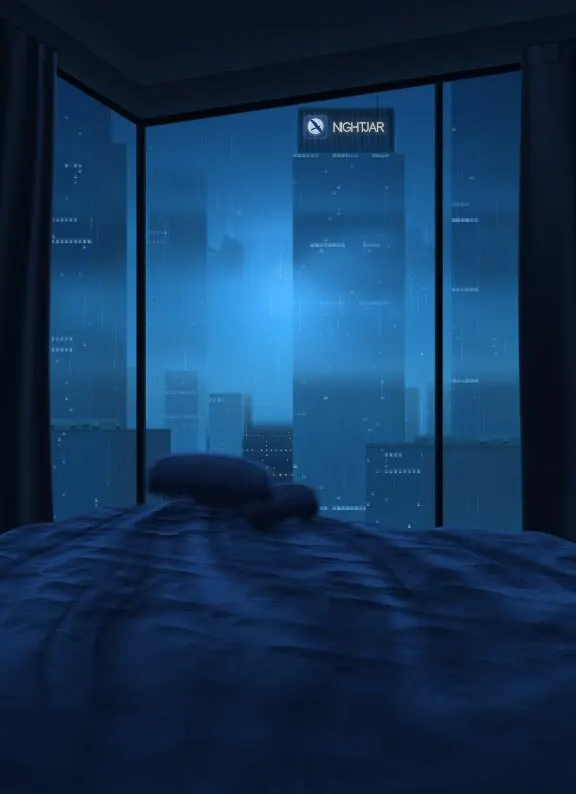
Two office towers seen from below at blue hour, the moon between them. On the left a tall tower, its top out of the picture, square with its corners cut and fins on every bay; on the right a shorter slab with ribbon windows and a crown that carries a sign, a spire with red lights, and a window-cleaning crane against the sky.
The towers’ faces stay crisp, and their life is in their glass and their rooms. Low cloud goes over behind them, lit from under by the city and the moon, high cloud slides from the west across its own wisps, and its shapes slide across the towers’ glass, a little differently in each column of panes. Rooms light up and go dark. Every track has a moving cover drawn live, and in the player the picture moves with the sound and rests when you pause.
When to play it
It is a focus track of 60 minutes for work or study at the end of a day, and it keeps playing after the hour. Its evidence label is Comfort sound: no research reviewed, not a treatment. For choosing a background for work, see sound for deep work and sound for studying.
How it is put together
- No beat
- A warm pad holds one chord while its notes ripple in turn, over a deep bass and a soft, round kick
- Every few minutes the sound slowly opens and brightens, then sinks back into the dark
- It keeps playing quietly until your timer fades it out
What research says about what plays
- Comfort sound
Ambient sounds
No research reviewed. Many people find these sounds calming; this is comfort, not a treatment.
Not reviewed
These are the app's own notes, last checked against the research on 30 Oct 2026. Labels: what each one means.
Questions
Does After Hours have a binaural beat?
No. The soft kick is a slow drum, about 56 beats a minute, not a binaural beat or pulse, so the track needs no headphones.
Can I lower the drums?
Yes. Tune turns any sound down on its own, even parts of a track: the thunder apart from the rain, the saxophone apart from the piano. After Hours has three parts: Pad, Bass and Drums.
Does After Hours loop?
No. Nightjar makes its sound live on the iPhone: none of it is a recording and none of it loops. Its riffs and its slow opening and closing are composed as it plays.