 Nightjar
What it sounds like
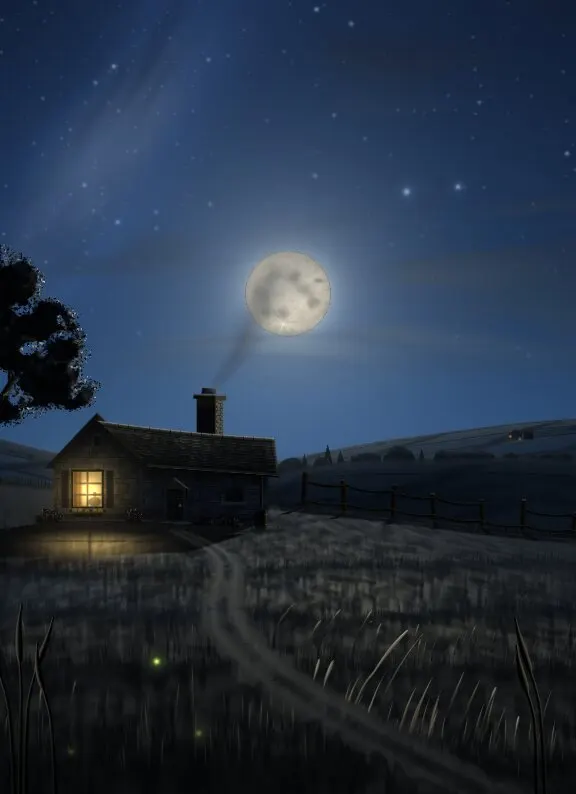
A warm night in summer, a field or a garden full of crickets. Close by and far off, field crickets chirp, a quick burst of three to five pulses repeated two to four times a second. Under them, tree crickets trill without a break, softer and a little lower. The chorus never quite settles: neighbours fall into step for a while, drift apart, go quiet and start again.
How it is made
Nightjar makes its sound live on the iPhone: none of it is a recording and none of it loops. The chorus is built from how crickets actually sing, with numbers taken from published recordings and research on cricket song.
Field crickets. 24 voices. A field cricket sings by rubbing a file on one wing against a scraper on the other, and a stiff patch of wing rings at nearly one pitch, about 4.8 kHz here. Each pulse lasts about 24 milliseconds with a smooth rise and fall, and its pitch drops about 8 per cent as it dies away, because the scraper slows. Three to five pulses make a chirp, and a chirp repeats two to four times a second. Each cricket has a pitch, a rate and a distance of its own.
Tree crickets. 8 voices, trilling without a break at 2.6 to 3.7 kHz, 31 to 50 pulses a second. They are the quieter part of the chorus, about an eighth of its power, and their trills build and die away over half a second.
A chorus, not a crowd. Each field cricket keeps its own time, but every chirp nudges the timing of the others a little, so neighbours partly lock together and drift apart again, in clusters that move as one for a while. Crickets fall silent and start again in bouts of seconds to a minute, and now and then a third of the field goes quiet for several seconds and comes back out of step. One shared temperature slowly moves every rate by a few per cent: the cooler the night, the slower the chirps.
Where they are. Each cricket has a distance and a place left or right, and the farther ear hears its pulse a fraction of a millisecond later. A small outdoor space of reflections puts air around them. No single cricket stands out of the rest.
When people use it
Summer nights, any time of year. Crickets mean warm, still evenings to many people, and they have nothing to follow. In Nightjar they sing with a brook and a little wind in Creekside Night, with frogs and water in Summer Pond, and far off in Short Nights.
With other night sounds. They pair well with frogs, a stream or a nightjar. More nights outdoors are in Nights outside.
Because crickets are high and bright, they cover little low noise on their own. Keep them quiet, and let the timer above fade them out.
Tracks with crickets in them


What research says
- Comfort sound
Ambient sounds
No research reviewed. Many people find these sounds calming; this is comfort, not a treatment.
Not reviewed
These are the app's own notes, last checked against the research on 30 Oct 2026. Labels: what each one means.
Questions
How do crickets make their sound?
A male cricket rubs a toothed file on one wing against a scraper on the other. Each tooth sets a thin, stiff patch of wing ringing, which is why the song is close to a pure tone, around 4 to 5 kHz in field crickets. One closing stroke of the wings makes one pulse, and a few pulses make a chirp.
Do crickets chirp faster when it is warm?
Yes. Crickets are cold-blooded, so their muscles run faster in warm air, and the chirp rate rises with temperature. This is known as Dolbear's law. Here a slowly changing temperature moves every cricket's rate a few per cent together.
Are crickets too high-pitched to sleep to?
Some people find them bright. They are high, mostly between about 2.6 and 5 kHz, so they cover little low noise. Keep them quiet, or play them over a low bed as Creekside Night does with a brook and brown noise.