 Nightjar
Thunderstorm sounds for sleep, without the startle
Sleep, rain, 45 min
That was the two-minute preview, the same the app gives without Plus. The whole track plays in Nightjar, with the screen off and a timer that fades it out.
Coming soon to iPhoneWhy storms are tricky at night
A steady sound is easy to sleep through. A storm is not steady: thunder is an event, and events are what wake people. The research on night-time noise makes the point clearly. A 2018 systematic review for the World Health Organization pooled sleep-lab studies of traffic, rail and aircraft noise and found that each 10 dB increase in a noise’s loudest moment indoors raised the odds of waking by about 35 percent. The average level matters less than the peaks.
So the trick is not avoiding thunder, it is keeping its peaks low and its edges soft.
What makes a storm good for sleep
- Far, not near. Distant thunder is a low roll that rises over a few seconds. Near thunder is a crack. Choose the first.
- Long quiet between rolls. A storm that rumbles every few seconds keeps you listening. Long gaps of plain rain let you settle.
- Rain carrying the sound. The rain should be the main sound, with the thunder underneath it, not on top.
- No surprises. No sudden lightning cracks, no dogs, no sirens.
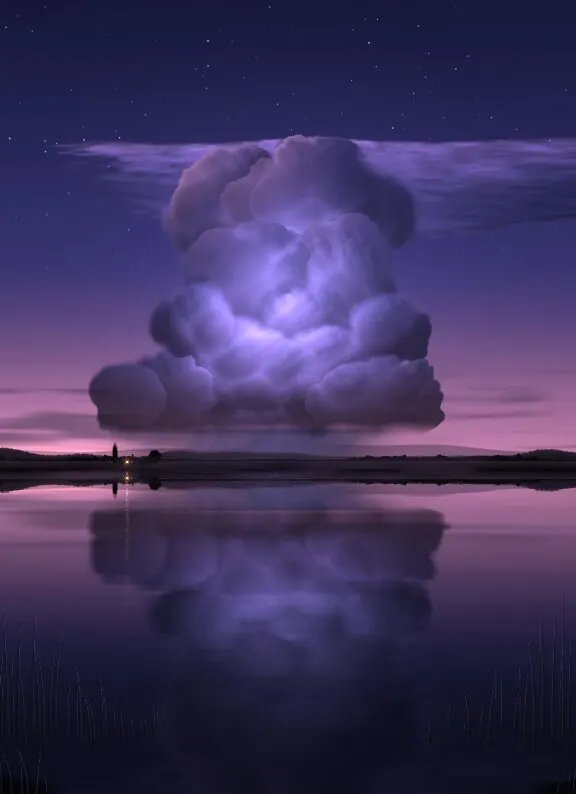
Press play above for Distant Storm: thunder rolling far off over steady rain and a low brown-noise bed. The thunder rolls for seconds and never cracks, with long quiet between, and a warm pad and a slow drift from 8 to 2 Hz sit underneath. It keeps playing quietly until your timer fades it out.
Turn the thunder down, not the storm
If a storm is almost right but the thunder is too much, lowering the whole track also lowers the rain that was helping. It is better to lower the thunder on its own. Some apps let you do that; with a simple player, try a quieter storm instead.
Level and distance
Keep the overall level low, around a quiet background conversation or softer, with the speaker across the room. The Sleep Foundation suggests starting with the source in a corner. Storms have a wider range between quiet and loud than plain rain, so set the level during a roll of thunder, not during the rain: if the roll is comfortable, the rest will be.
When to use a storm, and when not to
Good for: winding down, reading in bed, a stormy-night mood when you are not trying to sleep yet, and some people’s whole first hour of sleep.
Not good for: light sleepers, nights when you are anxious, or all-night play. A 2021 review of 38 studies found very low certainty that even steady noise improves sleep; a sound with deliberate events has less going for it, not more.
If you love storms but they keep you up, try this: storm in the evening, then switch to plain rain or window rain at lights-out.
Storms to try
| Track | What it is | Beat |
|---|---|---|
| Distant Storm | Far thunder over steady rain and brown noise | 8 to 2 Hz |
| Thunderstorm | Heavy rain, thunder rolling over, wind in the trees | None |
| Storm over the Loch | Heavy rain round an old castle, thunder beyond the hills | None |
| Parked in the Storm | Rain drumming on a car roof, thunder rolling through | None |
More are in storms from inside. On its own, thunder is a single layer you can mix under rain.
Where Nightjar helps, and where it doesn’t
Tune turns any sound down on its own, even parts of a track: the thunder apart from the rain, the saxophone apart from the piano. That is the fix for a storm whose thunder is a little too present. Nightjar makes its sound live on the iPhone: none of it is a recording and none of it loops. So a storm never repeats: there is no loop of the same clap. Set the level during a roll of thunder, and the rain takes care of itself.
Nightjar cannot make thunder into a sleep aid. The app labels its ambient sounds Comfort sounds, with no research behind them as treatments, and a storm is a comfort sound with more risk than most. If you wake to it, plain rain is the better choice.
Sources
- Basner and McGuire, WHO Environmental Noise Guidelines for the European Region: a systematic review on environmental noise and effects on sleep, 2018
- Riedy, Smith, Rocha and Basner, Noise as a sleep aid: a systematic review, Sleep Medicine Reviews, 2021
- Sleep Foundation, White Noise (updated 29 July 2025)
Last checked 13 November 2026.
Questions
Can thunderstorm sounds wake you up?
They can. A sudden loud clap is exactly the kind of peak that wakes sleepers. Storms made for sleep keep the thunder distant and rolling, without cracks, and keep its loudest moments modest.
Is a thunderstorm better than plain rain for sleep?
Not in any study. Plain rain is steadier and safer for light sleepers. Some people find distant thunder cosy and drift off better with it; if that is you, keep it low and far.
Should I play storm sounds all night?
Usually not. A storm has events by design, and events are what you want fewer of once you are asleep. Let a storm fade after you drop off, or switch to plain rain.